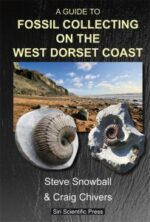

This is a guide to the collection, preservation and display of fossils from more than 50 locations in the UK. It is unashamedly based on the UK fossils format, but obviously, rather than being an online resource, it is a pocket sized book to be taken and read on site.

Almeria is a province in southeast Spain, situated in the furthest southeast part of the Iberian Peninsula. And it is a classic area for southern European and Mediterranean Neogene and Quaternary geology. In fact, it is not far north of the southern boundary of the European tectonic plate and, as a result, has been profoundly affected by the interaction of this and the African plate.

Geology of South Wales

I quite like regional guides books, even about areas I haven’t been to and am unlikely to visit. That isn’t the case for South Wales, which is one of my favourite areas in the UK for both scenery and geology. Therefore, this guide is another good addition to my collection and will no doubt accompany me soon on another holiday in the Principality.

Those of you who have read a few of my book reviews will know that I love geo-guides to small geographical areas, rather than just the big geological scientific issues. In fact, there are lots of good UK guides like this one, to areas such as Dorset and Yorkshire, and many areas of Scotland and Wales, for example. And this is another excellent example of that genre.

The fossil bearing rocks of the British Isles contain the remains of life from the last 2,900Ma and the UK is seen by many as the cradle of modern geology. With this is mind and using a geological map of Britain, palaeontologist Peter Doyle offers a comprehensive guide to UK fossils.

Graptolites lived in the earth’s oceans from 540 million years ago to 320 million years ago, when they became extinct. The book provides a summary of the state of knowledge relating to graptolites, and the specialists, who contribute to the book, also address the biological questions raised by these fossils, and provide pointers for further research.

This was the first GA guide I ever bought, and I suspect it is still the best. My copy is more than well-thumbed and water-damaged, through many a happy trip to the south of England to collect, what a friend describes as “white fossils in white rock”.

The graptolites constitute one of the geologically most useful taxonomic groups of fossils for dating rock successions, understanding paleobiogeography and reconstructing plate tectonic configurations in the Lower Palaeozoic.

This is another of GA’s guides, this time to the geology and geomorphology of the popular holiday destination of the Castleton Area in Derbyshire. I love this area and have visited there both for the geology and the beautiful scenery.

Red Coast Revealed

The Jurassic Coast Trust has certainly producing some good books. As is well known, in recognition of its wonderful geology, the coast between Orcombe Rocks in southeast Devon and Old Harry Rocks in south Dorset was granted World Heritage status in December 2001. In this respect, these two guides cover the western and the eastern thirds of this remarkable coastline.

I always wait expectantly for the publication of a new Palaeontological Association guide to fossils and, when they turn up, I am never disappointed. This is undoubtedly another triumph. This guide attempts to bring the diversity of its flora and fauna together in a single work, for the first time.

The Geologists’ Association have extended their excellent series of geological guides by producing what some people (including me) would think at first was a slightly self-indulgent couple of volumes on ‘Devonshire Marbles’. However, for my part, I soon realised that this view is entirely wrong.

As the author says, “The abundance and diversity of Foraminifera … make them uniquely useful in studies of modern marine environments and the ancient rock record”. And this book represents an interesting, enjoyable and informative ‘one-stop-shop’ treatment of precisely that subject.

The second edition of Microfossils, published in 2005, is still the definitive guide to all the major microfossil groups and the essential reference tool and laboratory guide for undergraduate and graduate students of micropalaeontology.

I have known Neale Monks for many years. He knows his stuff and some of that stuff is ammonites. Their beautiful spiral shells make them among the most sought after. However, until this book was published in 2002, little had been published about ammonites other than in geological journals.

I sat down to read this over Christmas and what a good read it turned out to be. The appropriate word is ‘eclectic’ – because Measures for Measure is written for all us with an interest in the industrial history of Great Britain, and its impact on the landscape, economy, social history and culture.

South Wales is a great place to do geology, both because of the variety of what can be seen and the general beauty of the area and its surrounds. In fact, the sedimentary rocks here (largely from the Palaeozoic and late Triassic/Lower Jurassic) were deposited in a wide range of environments, for example, deep-sea fans, clastic-carbonate shelf seas, beaches, estuaries and deltas, and rivers and floodplain swamps, to name but a few.

This is a lovely little book – the sort I would want to write. It is beautifully illustrated and well researched, with more than 200 glossy photographs and always interesting comments on the subject matters it touches upon. In short, it is a delight.

There are a lot of guide books to the Jurassic Coast Work Heritage Site and I have reviewed several on this site. This one is intended to provide a useful introduction to the general geology of the coastline, dealing with its formation, fossils and plate tectonics (among many other things). Specifically, the advice is provided in the context of walks – for both afternoon rambles and long distance hikes for the more committed.