
This is a nice little guide for the non-specialist collector of all things that go bump from above (and the effects they have on the rocks they impact).

This is a nice little guide for the non-specialist collector of all things that go bump from above (and the effects they have on the rocks they impact).
I’ve been waiting for a book like this for a very long time and am delighted that a publication of this quality has now arrived. New books covering British palaeontology are always welcome.
Professor Robert Diffendal Jr’s little guidebook to the Great Plains of the USA makes for a fascinating read for an Englishman like me, who has never been there (but wants to). He makes it plain that they rarely correspond to the impression most people have of them.
Fossil Hunting along the Jurassic Coast is presented by Dr Colin Dawes, a well-known, fossil hunting guide in the world-famous palaeontological site of Lyme Regis.
West Dorset is rightly famous for its fossils, but few people visit its wonderful, fossiliferous cliffs to look at them as landforms, rather than as an endless source of ammonites and belemnites. This guide does just that and, covers a series of itineraries in the context of landform type.
This is another of the GA’s short guides, being only 21 pages long and therefore easy to put in a cagoule pocket. Importantly, the five excursions described in the guide are centred on the city of Plymouth. Therefore, the logistics necessary to visit the itineraries should be relatively easy.
This GA guide is intended as a major guidebook to the exposures of highly significant Precambrian, Carboniferous and Permo-Triassic sediments, through to Jurassic rocks of the East Midlands. Personally, it is an area I only partly know (I know Edale in the Peak District quite well) and, for that reason, is an interesting set of locations for me.
This GA guide is stated to be a “Geology Teaching Trail”. Well, it may be, but when I ambled along the trail with the guide in my hand, I certainly wasn’t in a teaching situation. Rather, I was out for a nice walk and a guide to explain what I was seeing. And it did just that and the classic Silurian/Ordovician unconformity you can see was just that. Classic!
The aim of the guide is to help professional and interested amateur geologists to investigate the rocks themselves and to put them in a modern scientific context.
Ever since Charles Darwin pointed out the problem, evolutionary biologists have been worried by the incompleteness of the fossil record. Fortunately, discoveries of formations containing exceptionally preserved fossils (conservation Lagerstätten) have provided fascinating and important information on the history life’s diversity.
Shropshire is one of my favourite areas for both geology and fossil collecting. The Silurian of this beautiful area is fascinating and, if you can get permission to get into one of the commercial quarries (and you will need permission), then the results will be remarkable.
After having favourably reviewed the first two books in this three part series, I must admit I was very much looking forward to the publication of this last one. And, of course, I wasn’t disappointed. This is the third in a series of guides to safe and responsible fossil collecting along (this time), the East Dorset coast from the Chalk cliffs at Bat’s Head, across what are some of Dorset’s more remote coastal locations, to Hengistbury Head.
This is an ambitious little field guide, which aims to allow amateurs to identify basic rocks and rock formations, for the first time, in a systematic way., as it says: “… using only careful observation, a magnifying glass, a pocket knife – and a bit of patience”.
I approached this book with what turned out to be completely irrelevant preconceptions. I was very wrong. In fact, this is a little geological tour de force describing field locations and, what one reviewer described as “the logic of geology: how vanished land – and seascapes can be conjured back into existence from the raw rock record”.
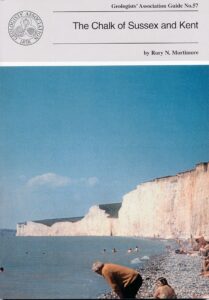
I like local geological guides, which aim to get you out and about, visiting areas you might not have known are worth a daytrip. And this is a good example. I sat down and read it cover to cover, as it is only 90 pages long. And I now really want to visit this bit of Kent coastline. Largely concentrating on the Upper Cretaceous Chalk, this guidebook explains and illustrates what seems to be some marvellous geology that can also be explored during what could be a lovely day out on the beach.
This is one of GA’s little guides to a very specific area. This one is West Cornwall, a holiday destination that I recently visited during which I spent some time looking at the geology, along with the gardens and archaeological sites.
This is another lovely guide by the GA to an area that perhaps readers would not associate with good geology. But, of course, that is because of its title, because the areas like Pendle Hill and Derbyshire are wonderful, not just to visit for their geology, but also for their holiday appeal.
In recent years, Graham Park has been prolific in his writing for Dunedin Academic Press. In this new tome, he has produced what I suspect is a really great introduction to a range of key concepts and geological processes for both undergraduates and the interested, moderately well-informed amateur.
This is one of the oldest of the GA’s guides and is currently in its third edition (the first having been published in 1957 and the second in 1972). Although there have been changes in classification and so on, the general exposures are largely as good as they used to be – or they were the last time I went!
This book would seem to be the follow up to the well-received A History of Life in 100 Fossils. However, this time, this glossy hardback tells the story of plants on earth using significant fossils that are, for the most part, kept at the Natural History Museum in London. Like that other book, it is set out in a simple format, in which a couple of sides of text are used to describe a full page colour photograph of the fossil in question.
I like fossils, but it is always nice to have a brief but informative guide to the actual science behind one’s finds. And this Dunedin guide certainly fits the bill for amateurs and undergraduates alike.
Trenton Holliday’s excellent book, tells the story of Cro-Magnon people in the context of recent scientific advances. However, while it does not shy away from complex scientific issues, the book is written with a light, understandable touch.
This is a new guide in Dunedin’s ‘Introducing …’ range of books, covering the branch of geology that studies rock layers (strata) and layering (stratification), primarily in sedimentary rocks, but also layered igneous rocks. In this way, it is intended for students and amateur geologist, rather than the academic earth scientist.
I really like the ‘Introducing ….’ series publish by Dunedin Academic Press, as you will have ascertained, if you have read the many reviews I have included in this magazine. This second edition of Introducing Sedimentology by Stuart Jones updates the version I reviewed a while ago (see Book review: Introducing Sedimentology, by Stuart Jones), and I found it equally enjoyable.
The is a second edition of Prof John Cope’s excellent geological guide to the Dorset coast for the Geologists’ Association. It is slightly shorter than the first edition, with some minor corrections and some of the figures revised, together with new photographs. It also now includes the huge quantity of data amassed over last few decades during the hydrocarbon exploration work in the county.