
This is the first of a two-part series of monographs on spiders (and arachnids more generally) involving Dr David Penney and published by Siri Scientific Press – the other is reviewed at: Fossil Arachnids: Monograph Series Vol 2. This one is written with Dr Paul Selden, who has more than 30 years of researching, and teaching about, fossil arachnids.

This is the much anticipated 4th edition of the GA’s Yorkshire Coast guide and it was well worth the wait. From personal experience, I was aware that the previous editions were extremely good for any geologist – professional, academic or amateur – who is attracted by the wonderful scenery and fascinating geology of this part of the UK coastline. However, this new edition is altogether an even better product.

Andy Gale’s update of his guide to the Isle of Wight (this is the sixth edition) is an important change to an already excellent geological guide.

As I said in my review of the first edition of this guide, I love geomorphology. In fact, I have loved it since my school days and deeply regret not having studied it at university. However, as I said in that review, I suspect many people are discouraged by its scientific name, but all it means is the study of the earth’s landforms and the processes that create the landscapes we see today.

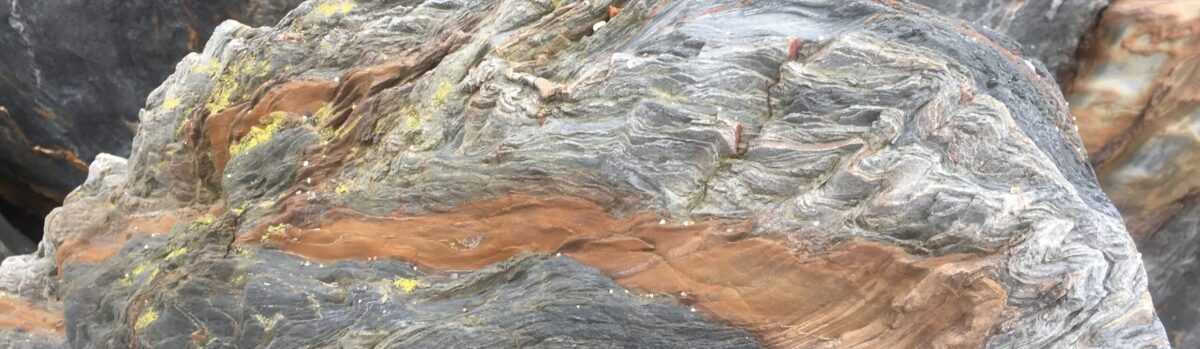
This Dunedin Academic press guide provides, at an introductory level, a succinct and readable guide to metamorphism. As readers will know, metamorphic rocks are one of the three main types of rocks.

This is another of Dr David Penney’s (founder and owner of the excellent Siri Scientific Press, whose books I have frequently reviewed in this magazine) books on fossil spiders and insects. It is co-written with Dr James Jepson, whose research in Germany has involved studying fossil insects preserved in rock.

This GA guide was first published in 1995 and is a great example of the sort of guide that the association still produces – coverage of small(ish), but important areas, where the geology is both fascinating and important. This one contains general descriptions of the geology and geomorphology of this part of west Wales, with 19 separate itineraries, written by 11 experts in their fields.

I think the reason why this book is such a success is that River Planet not only introduces readers to the fascinating palaeo-history of the world’s rivers (both existing and disappeared), but also reveals the author’s personal account of his experience of rivers, together with a bit of history and interesting (and relevant) anecdotes, in the most entertaining of ways.

Dr David Penney, founder and owner of the excellent Siri Scientific Presshas writen about Miocene spider inclusions in amber from deposits of the Dominican Republic. This is one of the many books on fossil spiders and insects that Siri Scientific Press publishes.

This is the second of a two-part series of monographs on spiders (and arachnids more generally) involving Dr David Penney (the first is Fossil Spiders: The evolutionary history of a mega-diverse order – Monograph Series Vol 1). This one is written with Jason Dunlop, who has described numerous new fossil species in a variety of arachnid groups, from scorpions to harvestmen, to mites and even some extinct groups.

The second edition of this guide is written to explain the key concepts of tectonics and rock structures to students and to interested amateurs. I have reviewed a number of Graham Park’s books in recently years (see below) and he is clearly a prolific and excellent writer of books about the earth sciences.

Growing up, I collected and purchased trilobite fossils for my own personal collection, to learn about and understand prehistoric life. They were to me, and still are, a fascinating group of fossils to examine and wonder about how the myriad of different forms evolved.

This is an interesting guide for someone like me who lives in the Southeast of England. In fact, I have commuted from London to Brighton by train, which took me through a cross-section of the Weald, which is the subject matter of this guide.

As the author, John McManus, writes: “The East Neuk of Fife was blessed with a mineral resource that was relatively easy to access”. This resource was coal – the driver of the industrial revolution and, even before then, a crucial element to the area’s industrial development from medieval times (or even Roman times) to the late twentieth century.

I like palaeoart. A while ago, I went to the ‘Dinosaurs of China’ exhibition in Nottingham and bought myself a copy of the Chinese palaeoartist, Zhao Chuang’s ‘The Age of Dinosaurs’ – a veritable picture-fest of up-to-date reconstructions of ancient beasts and plants, complete with fuzzy raptors and other bird-like therapods.

I have to admit, I was beginning to wonder where Prof Rory Mortimore’s update of his excellent Chalk of Sussex and Kent was. And now I know. It wasn’t a second edition he was working on, but this magnificent magnum opus in two volumes covering a vastly greater area than that other guide. And the wait was more than worthwhile. The thoroughness, writing quality, content and publication standards are superb.

The Crowood Press are really developing a nice little series of books on the landscape and geology of select regions of the British Isles, and Tony Waltham’s addition to the series about the Peak District is well worth a read. This new one follows the same format as the others – beautiful, full colour photos and diagrams, a fascinating chapter on each of the important geological and geomorphological aspects of the area (including buildings and industry), and an author who knows his stuff and can write it down with an easy and authoritative style.

I’ve been waiting for a book like this for a very long time and am delighted that a publication of this quality has now arrived. New books covering British palaeontology are always welcome.

West Dorset is rightly famous for its fossils, but few people visit its wonderful, fossiliferous cliffs to look at them as landforms, rather than as an endless source of ammonites and belemnites. This guide does just that and, covers a series of itineraries in the context of landform type.

In this second edition, Dougal Jerram has revised and updated the 2001 version, first published by Alwyn Scarth and Jean-Claude Tanguy. This is to reflect modern research and understanding of Europe’s volcanoes of the last 10,000 years (active, dormant and extinct).

This is another of the GA’s short guides, being only 21 pages long and therefore easy to put in a cagoule pocket. Importantly, the five excursions described in the guide are centred on the city of Plymouth. Therefore, the logistics necessary to visit the itineraries should be relatively easy.

This GA guide is intended as a major guidebook to the exposures of highly significant Precambrian, Carboniferous and Permo-Triassic sediments, through to Jurassic rocks of the East Midlands. Personally, it is an area I only partly know (I know Edale in the Peak District quite well) and, for that reason, is an interesting set of locations for me.

This GA guide is stated to be a “Geology Teaching Trail”. Well, it may be, but when I ambled along the trail with the guide in my hand, I certainly wasn’t in a teaching situation. Rather, I was out for a nice walk and a guide to explain what I was seeing. And it did just that and the classic Silurian/Ordovician unconformity you can see was just that. Classic!